Many-objective
Throughout this section, we will solve the three-objective problem DTLZ2 imported from pymoo.
The definition of “many-objective” differs according to the refence used. Some issues arise in maintaining population diversity in the survival stage for problems with more than two objectives. Therefore we will consider here “many-objective problems those with more than two objectives.
For more details about the algorithms used, please refer to the Algorithms section.
[ ]:
import matplotlib.pyplot as plt
from pymoo.optimize import minimize
from pymoo.util.ref_dirs import get_reference_directions

from pymoode.algorithms import GDE3, NSDER
from pymoode.survival import RankAndCrowding
DTLZ2
[ ]:
from pymoo.problems import get_problem

problem = get_problem('dtlz2')
[3]:
NGEN = 150
POPSIZE = 136
SEED = 5
GDE3-MNN
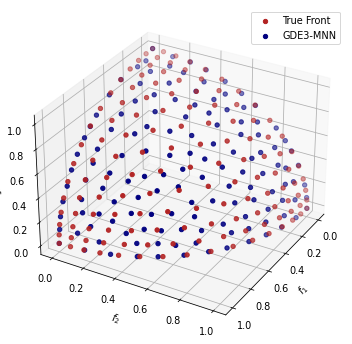
Let us instantiate a GDE3 algorithm and pass as the survival operator RankAndCrowding(crowding_func="mnn"), which is suitable for problems with more than two objectives. Alternatively, one could have directly imported the GDE3MNN algorithm.
from pymoode.algorithms import GDE3MNN
[ ]:
gde3 = GDE3(
    pop_size=POPSIZE,
    variant='DE/rand/1/bin',
    CR=0.2,
    F=(0.0, 1.0),
    gamma=1e-4,
    survival=RankAndCrowding(crowding_func='mnn'),
)

res_gde3 = minimize(
    problem,
    gde3,
    ('n_gen', NGEN),
    seed=SEED,
    save_history=False,
    verbose=False,
)
[ ]:
fig, ax = plt.subplots(figsize=[6, 5], dpi=70, subplot_kw={'projection': '3d'})

ax.scatter(
    problem.pareto_front()[:, 0],
    problem.pareto_front()[:, 1],
    problem.pareto_front()[:, 2],
    color='firebrick',
    label='True Front',
    marker='o',
)

ax.scatter(
    res_gde3.F[:, 0],
    res_gde3.F[:, 1],
    res_gde3.F[:, 2],
    color='navy',
    label='GDE3-MNN',
    marker='o',
)

ax.view_init(elev=30, azim=30)

ax.set_xlabel('$f_1$')
ax.set_ylabel('$f_2$')
ax.set_zlabel('$f_3$')
ax.legend()
fig.tight_layout()
NSDE-R
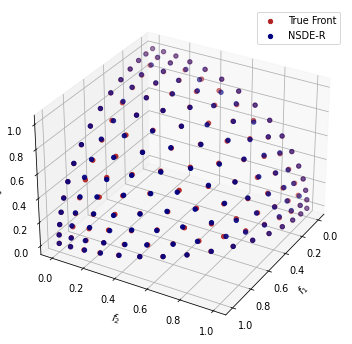
Let us now instantiate the NSDE-R algorithm, which uses DE reproduction operators with the survival strategy of NSGA-III.
[ ]:
ref_dirs = get_reference_directions('das-dennis', 3, n_partitions=15)

nsder = NSDER(
    ref_dirs=ref_dirs,
    pop_size=POPSIZE,
    variant='DE/rand/1/bin',
    CR=0.5,
    F=(0.0, 1.0),
    gamma=1e-4,
)

res_nsder = minimize(
    problem,
    nsder,
    ('n_gen', NGEN),
    seed=SEED,
    save_history=False,
    verbose=False,
)
[ ]:
fig, ax = plt.subplots(figsize=[6, 5], dpi=70, subplot_kw={'projection': '3d'})

ax.scatter(
    problem.pareto_front()[:, 0],
    problem.pareto_front()[:, 1],
    problem.pareto_front()[:, 2],
    color='firebrick',
    label='True Front',
    marker='o',
)

ax.scatter(
    res_nsder.F[:, 0],
    res_nsder.F[:, 1],
    res_nsder.F[:, 2],
    color='navy',
    label='NSDE-R',
    marker='o',
)

ax.view_init(elev=30, azim=30)

ax.set_xlabel('$f_1$')
ax.set_ylabel('$f_2$')
ax.set_zlabel('$f_3$')
ax.legend()
fig.tight_layout()
[ ]: